Request a demo
AI-powered data catalog · Discovery, lineage & governance

Know what data you have, where it comes from and whether to trust it

InsightDataCatalog harvests schemas and lineage from your databases, lakes, BI tools and pipelines, profiles and classifies every column, and adds glossary terms, quality rules and data contracts — one governed catalog every team can search, inside your environment.

  • 50+ source connectors
  • Confidence on every lineage edge
  • PII detection
  • On-prem or private cloud
InsightDataCatalog · Data Lineage ExplorerDemo data
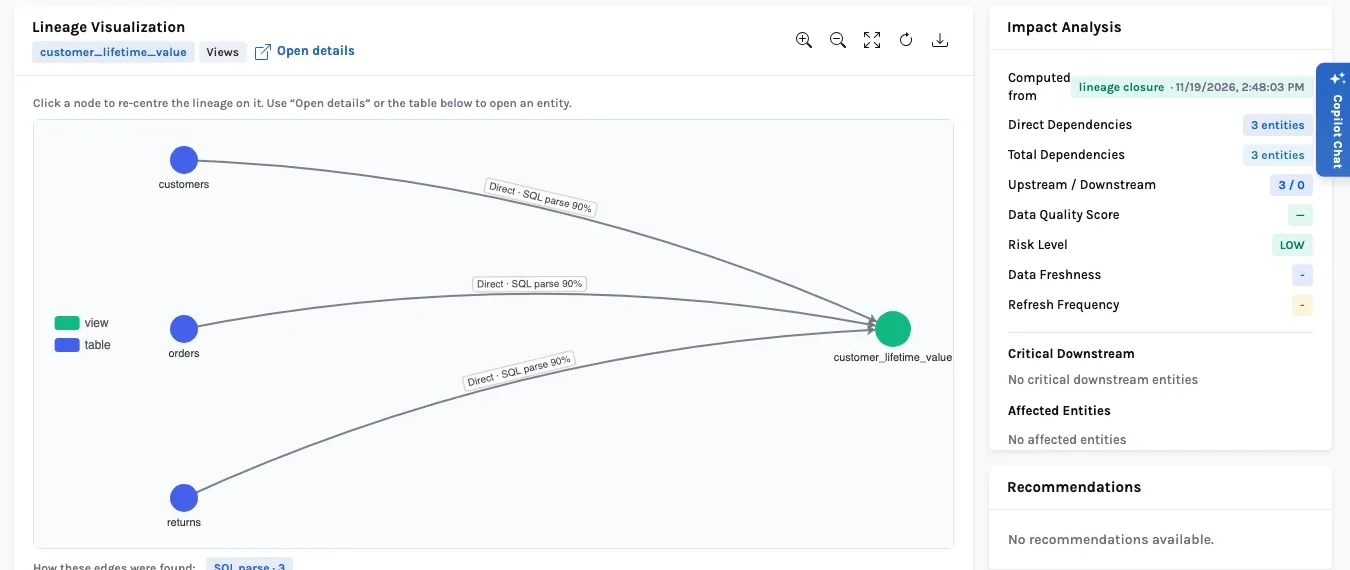
The Data Lineage Explorer in InsightDataCatalog: the view customer_lifetime_value fed by the customers, orders and returns tables, each edge labelled Direct, SQL parse 90%, with an impact analysis panel showing three upstream dependencies and a low risk level.

Discover

Schemas, columns, owners and profiles from every source — one search for every team.

Trace

Lineage from SQL, DAGs and job runs, each edge with its method and confidence, and impact before a change.

Govern

PII classification, quality rules, glossary terms and ODCS contracts — with people approving what matters.

How it works

From a source connection to data every team can find and trust

Connect, discover, govern, democratize — one platform across all four stages. The catalog does the harvesting and the first pass; your engineers, stewards and owners make the calls.

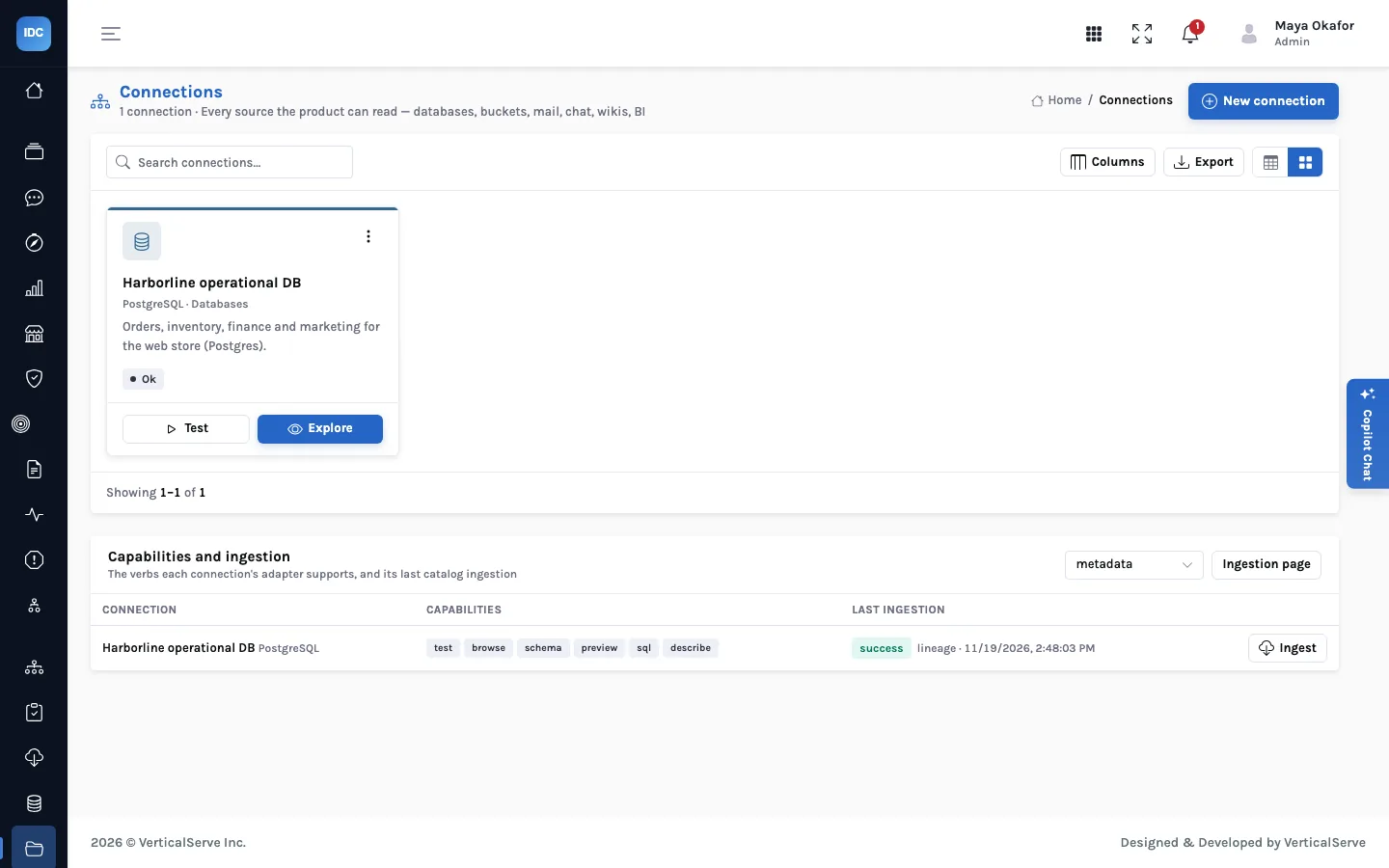
ConnectionsDemo data
The Connections page, close up: a PostgreSQL connection for a fictional retailer with Test and Explore buttons, and the capabilities each adapter supports (test, browse, schema, preview, sql, describe) next to its last ingestion.
Step 1

Connect sources

Databases, data lakes, cloud storage, BI tools and ETL pipelines — 50+ source types out of the box, read-only.

The catalog does

  • Tests each connection and lists what its adapter can do
  • Crawls schemas and metadata on a schedule
  • Records every ingestion run: added, updated, removed

Your team decides

  • Which sources and schemas to scan
  • Credentials, kept in your secret store
  • How often each job runs
Entity · ColumnsDemo data
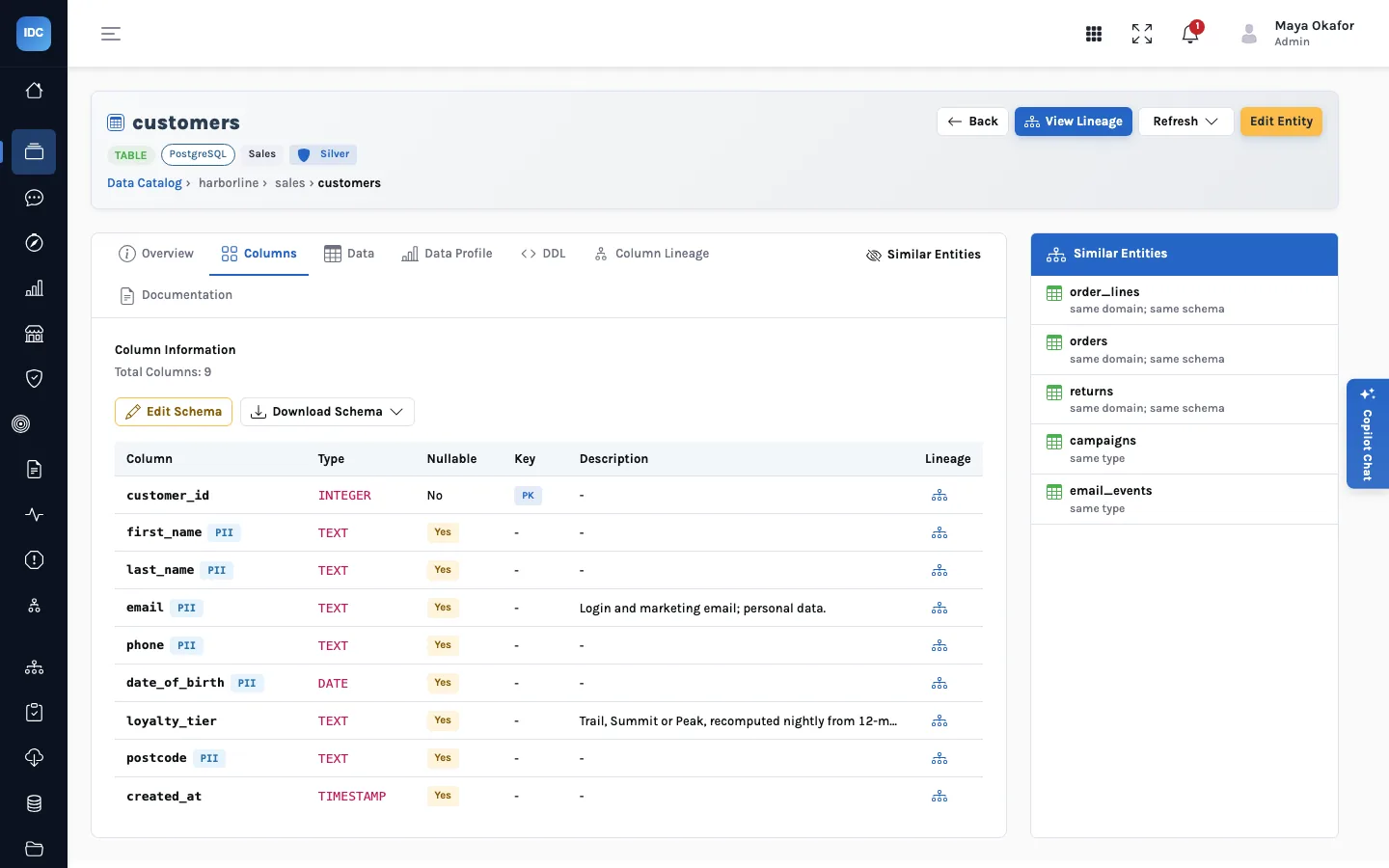
The customers table in InsightDataCatalog, close up: Silver certification, and its columns with types, nullability, a primary key and PII flags on name, email and phone.
Step 2

AI discovery

AI crawls, profiles and classifies your data assets — schemas, relationships and rich metadata.

The catalog does

  • Profiles every column: nulls, distinct values, ranges
  • Flags PII and sensitive data
  • Detects relationships, dependencies and smart tags

Your stewards decide

  • Confirm or reject each classification — a rejection is kept
  • Owners, descriptions and certification level
Data Quality StudioDemo data
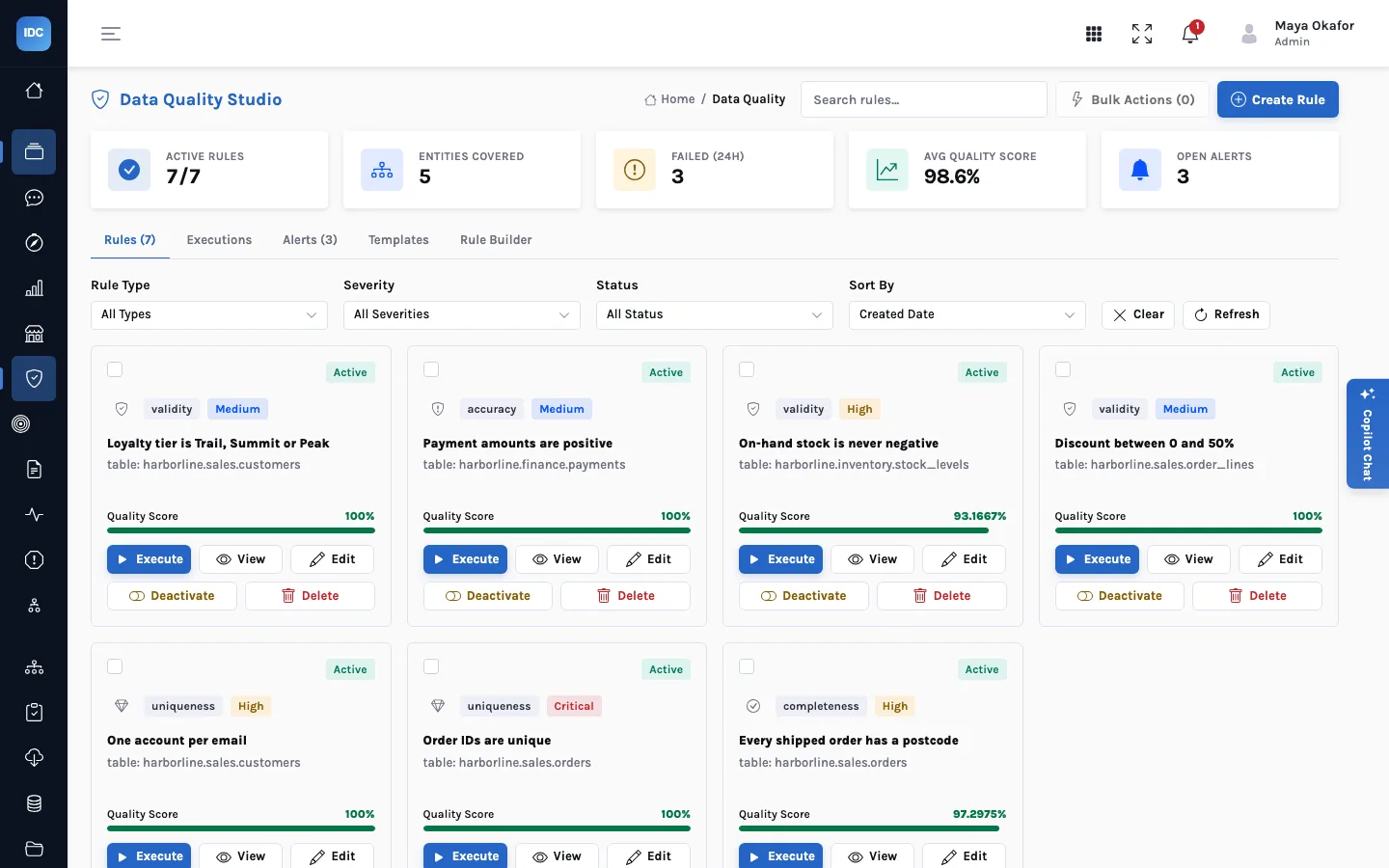
The Data Quality Studio, close up: seven active rules over five entities, three failed in the last 24 hours, an average quality score of 98.6% and rule cards with validity and accuracy checks.
Step 3

Govern & secure

Policies, sensitive-data classification, end-to-end lineage, quality scoring and access control.

The catalog does

  • Traces lineage from source to consumption
  • Runs quality rules on the live tables and scores them
  • Evaluates data contracts and opens violations

Your owners decide

  • Policies and who may access what
  • Approve proposed lineage edges and critical data elements
  • Approve each contract version
The product

What data engineers, analysts and stewards see

Real screens from InsightDataCatalog running on a fictional retailer’s database.

Lineage & impact

Lineage you can trust, with impact before you change anything

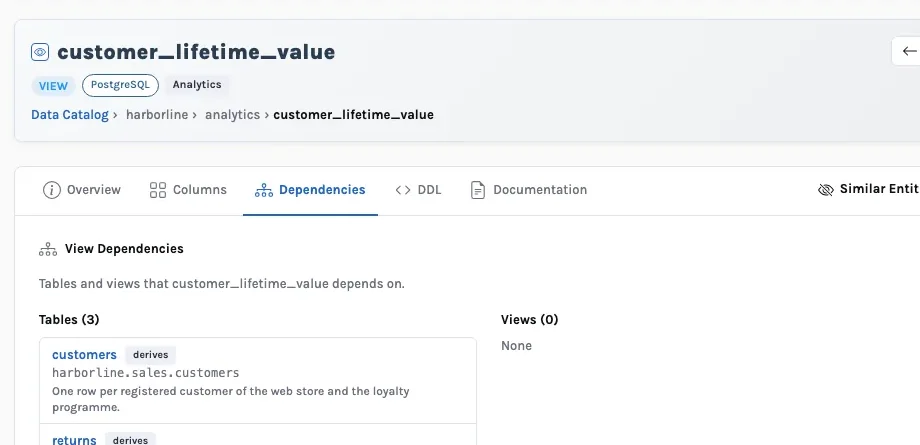
Lineage is parsed from SQL, views, procedures, DAGs and observed job runs. Every edge says how it was found and how sure the catalog is. Impact analysis walks downstream before a schema change or migration and lists the contracts and data products it reaches.

  • End-to-end, table- and column-level lineage
  • Impact analysis for migrations and schema changes
  • Dependencies and similar entities on every asset page
Entity · DependenciesDemo data
The customer_lifetime_value view's Dependencies tab: the customers, returns and orders tables it derives from, with descriptions, and a list of similar entities.
Data quality

Quality rules on the tables people actually read

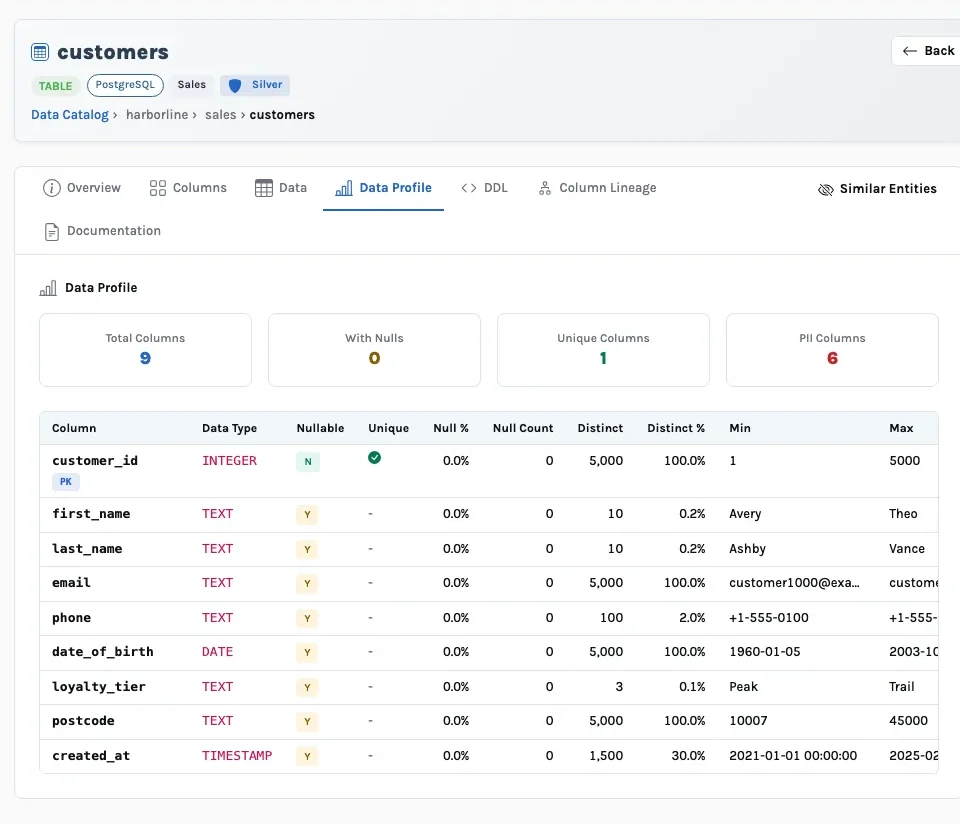
Validity, accuracy, uniqueness and completeness rules run on a schedule against the live table, not a copy. Scores, failures and alerts roll up to each entity, and the column profile shows what the data really looks like.

  • Automated quality scoring, profiling and monitoring
  • Data quality scores and freshness tracking
  • Rule templates and a rule builder
Entity · Data ProfileDemo data
The data profile of a customers table: nine columns, six PII columns, and per-column null rate, distinct count, minimum and maximum.
Data contracts

ODCS data contracts, drafted from the catalog

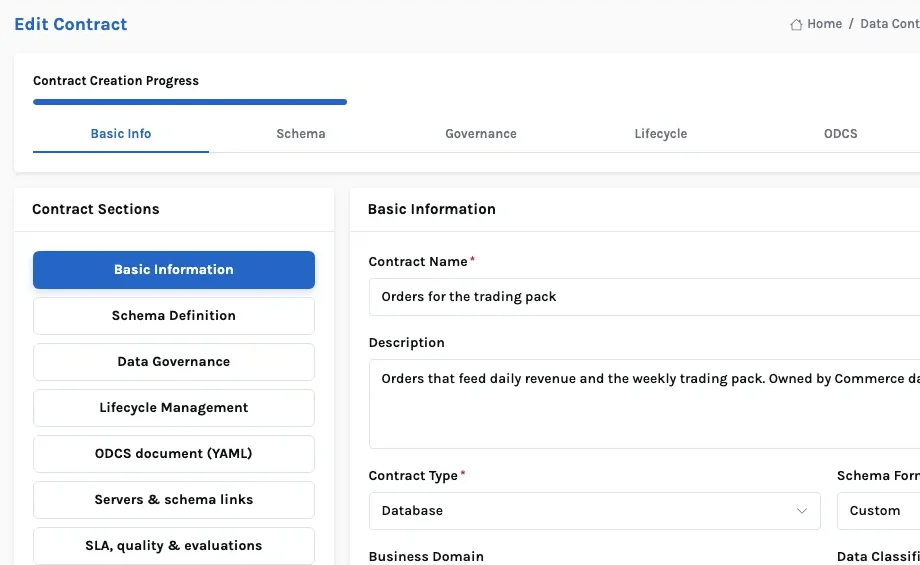
Draft a contract from a catalog entity: schema, quality checks, SLAs, servers and owners, exported as an ODCS v3 YAML document. The catalog evaluates it on a schedule and tells the consumers lineage finds downstream when it breaks.

  • Schema, governance, lifecycle and SLA sections
  • Approvals before a version goes active
  • Confluent and Apicurio schema registries for streaming contracts
Data Contracts · EditDemo data
Editing a data contract: tabs for basic info, schema, governance, lifecycle, ODCS, servers and evaluations, and the contract's name, version, description, type and business domain.
Glossary & CDEs

A business glossary linked to the columns that carry each term

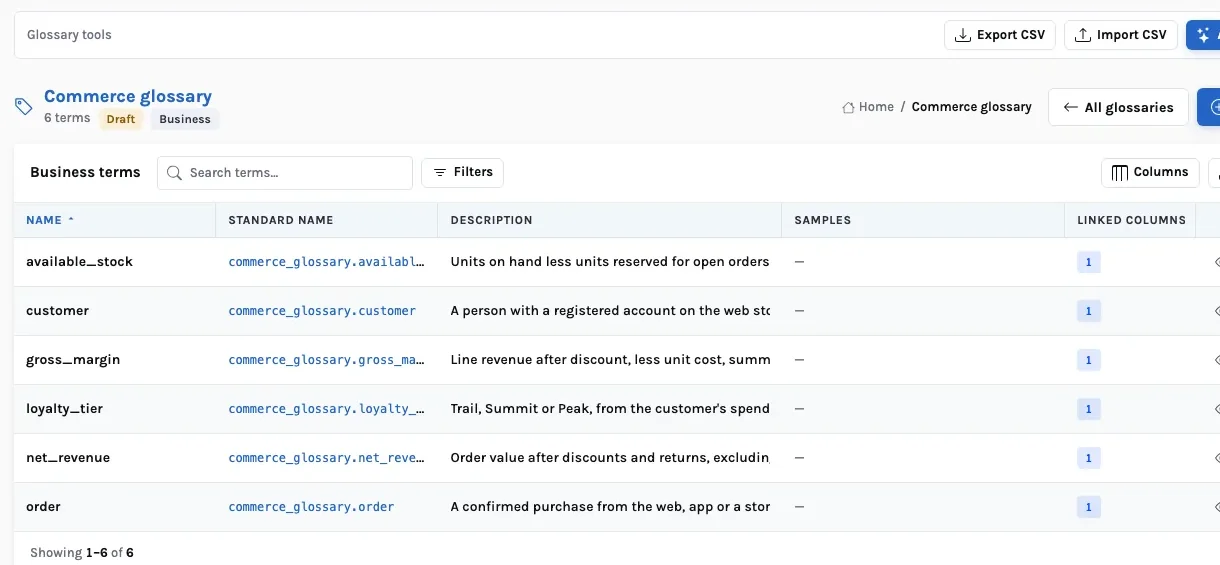
Unified business terms and a data dictionary in plain language. AI discovery suggests which columns carry a term; critical data elements get their own bindings, rules and scorecard.

  • Business glossary and data dictionary
  • Smart tagging and glossary mapping
  • Import and export as CSV
Commerce glossaryDemo data
A commerce glossary with six business terms such as available_stock, gross_margin and net_revenue, each with a standard name, a description and linked columns.
Usage & operations

See what is used, what needs attention, and every ingestion run

Usage analytics track data usage, popularity and access patterns. Entities needing attention surface failing rules by severity, and the ingestion log keeps every run with what it added, updated and removed.

  • Usage analytics and popular entities
  • Audit trails and stewardship workflows
  • Schema-change history per connection
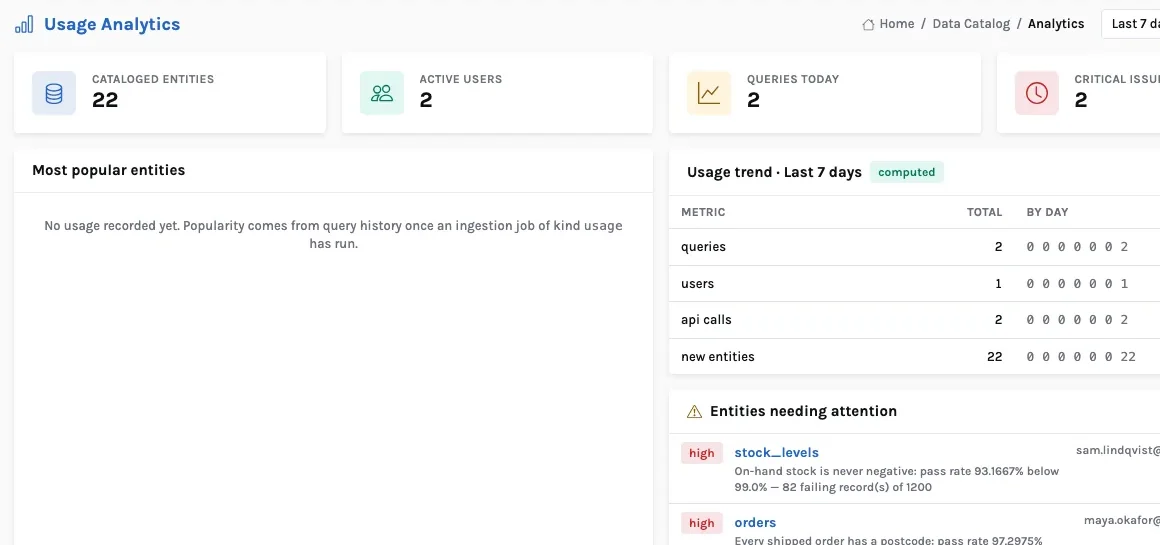
Usage AnalyticsDemo data
Usage Analytics: 22 cataloged entities, a seven-day usage trend and entities needing attention, with high-severity quality failures on stock levels and orders.
AI assist & MCP

Ask the catalog in plain words — from the app or from your AI tools

Assist answers questions over the catalog with typed tools for search, lineage, impact, quality scorecards, contracts, glossary terms and data products, and cites the catalog page behind each answer. The catalog’s own MCP server gives MCP clients the same answers through one guarded endpoint.

  • “What breaks if I drop this column?” — impact with contracts and products
  • “Which critical data elements are failing?” — scorecards and recent failures
  • Every MCP call is scoped, rate-limited, redacted and audited
How Assist and MCP work
Source coverage

Catalog data from any source — databases, lakes, BI, pipelines

Three groupings, one connector layer across your entire ecosystem: 50+ source connectors out of the box.

Databases & warehouses

Automatically discover and catalog schemas, tables and relationships across your operational and analytics stores.

  • PostgreSQL
  • MySQL
  • Snowflake
  • BigQuery
  • Redshift

Data lakes & storage

Profile and classify data assets in cloud and on-premise storage, with modern table format support.

  • AWS S3
  • Azure ADLS
  • GCS
  • HDFS
  • Delta Lake

BI tools & pipelines

Track lineage through ETL pipelines and catalog BI dashboards and reports, with downstream impact mapping.

  • Tableau
  • Power BI
  • Airflow
  • dbt
  • Spark
Capabilities

Eight first-class data-catalog capabilities

Automated discovery, intelligent governance and democratization — one platform, not three disconnected tools.

Automated discovery

AI-driven schema and metadata crawling and profiling across all data sources.

Data lineage

End-to-end lineage tracking from source to consumption.

Smart classification

Automated PII detection and sensitivity classification.

Usage analytics

Track data usage, popularity and access patterns.

Data quality

Automated quality scoring, profiling and monitoring.

Business glossary

Unified business terms and data dictionary.

Impact analysis

Assess downstream impact before schema changes and migrations.

API & integration

RESTful APIs, connectors and an MCP server for your tools.

Built for

Solutions for every team

How different teams use InsightDataCatalog to find, trust and govern data.

Data engineering

Accelerate pipeline development

Automate discovery and lineage so you stop hunting for tables and start shipping.

  • Automated schema discovery & profiling
  • Pipeline lineage & dependency tracking
  • Impact analysis for schema changes
  • Data migration planning & validation
Analytics

Find and trust the right data

Faster, more accurate insights when every analyst can see quality, freshness and provenance.

  • Self-service data discovery & search
  • Data quality scores & freshness tracking
  • Curated datasets & recommended sources
  • Collaborative annotations & reviews
Business users

Understand and access data without tech help

A plain-language business glossary, friendly access workflows and dashboard discovery.

  • Business glossary with plain-language terms
  • Data request & access workflows
  • Dashboard & report catalog discovery
  • Data literacy & documentation
Data governance

Govern at scale, audit on demand

Define policies once, enforce them everywhere, and prove compliance with one query.

  • Automated PII & sensitive-data detection
  • Policy enforcement & compliance tracking
  • Data stewardship workflows
  • Audit trails & regulatory reporting
Security & deployment

Your data never leaves your environment

Deploy on-premise or in your private cloud. Metadata processing happens inside your perimeter.

On-premise & private cloud

Deploy entirely within your infrastructure. Full control over your data catalog without external dependencies.

Data never leaves your network

All metadata processing happens within your environment. No data is ever sent to external servers or third-party services.

Compliance ready

Meet GDPR, HIPAA, SOC 2 and CCPA requirements with built-in audit trails, access controls and data classification.

Ready to take control of your enterprise data?

Join leading organisations using InsightDataCatalog to discover, govern and democratize their data. Tell us your sources and where you want to land — we’ll set up a hands-on walkthrough within 2 weeks.

  • On-premise deployment
  • No data leaves your network
  • 50+ source connectors
  • Enterprise support