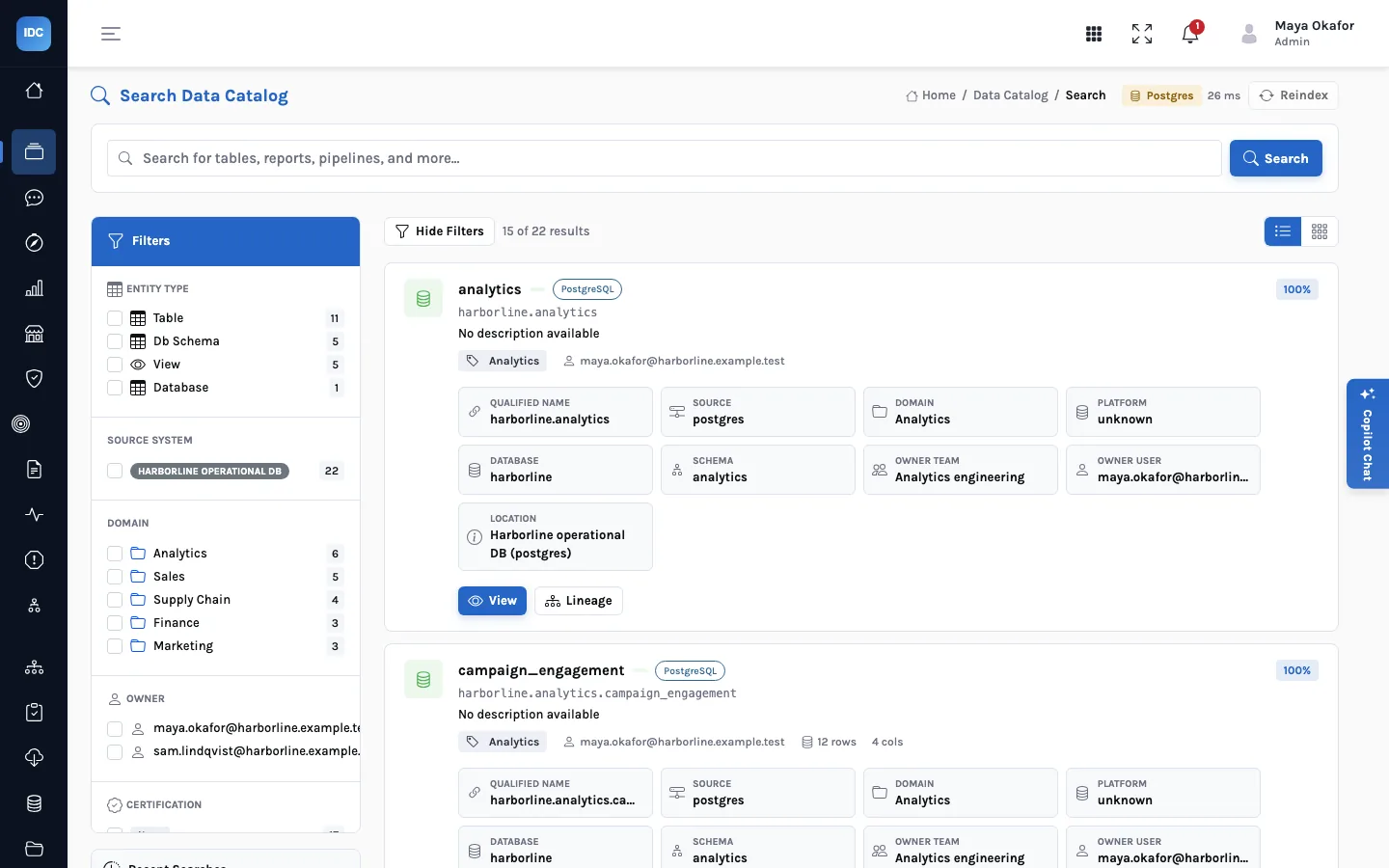
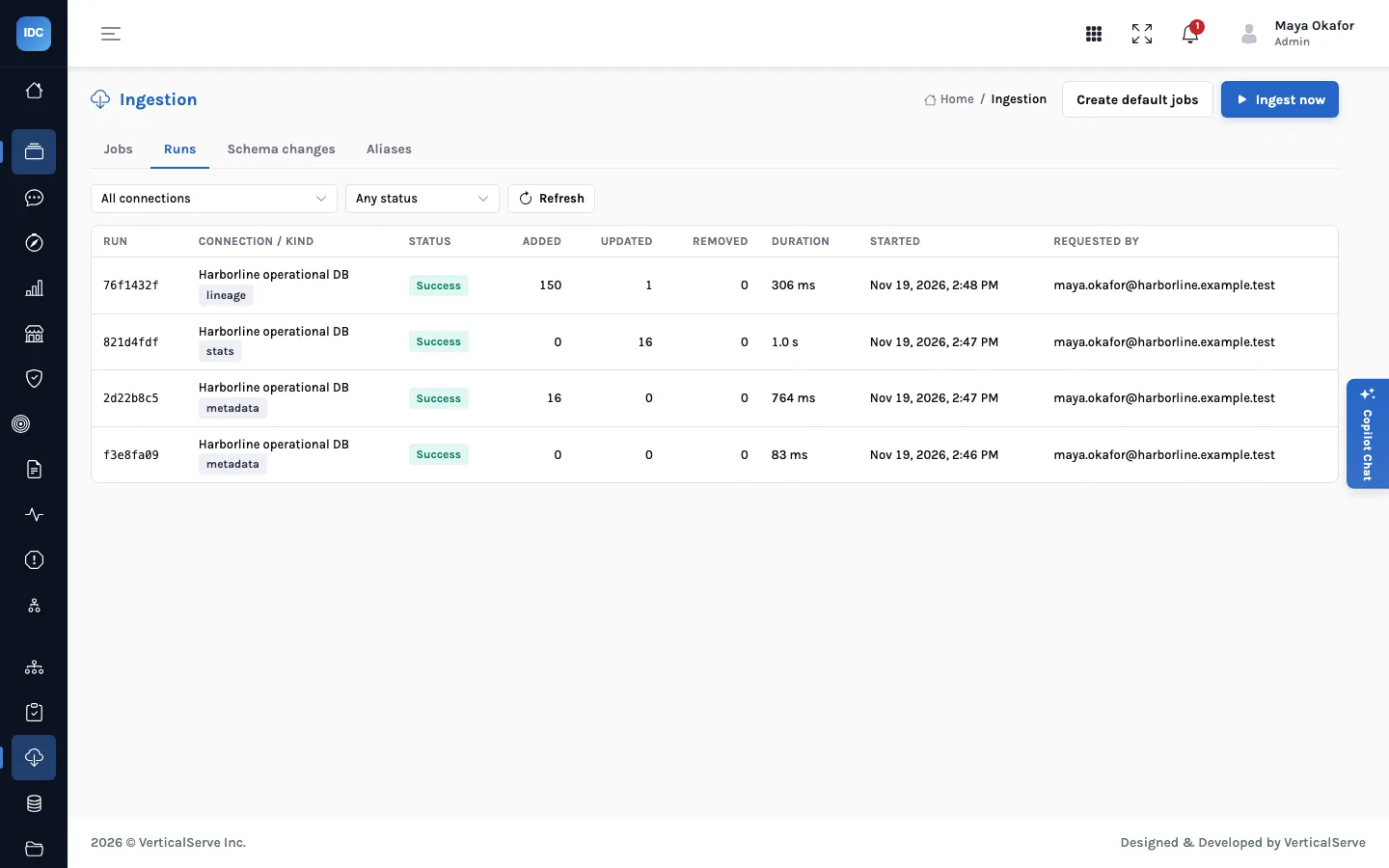
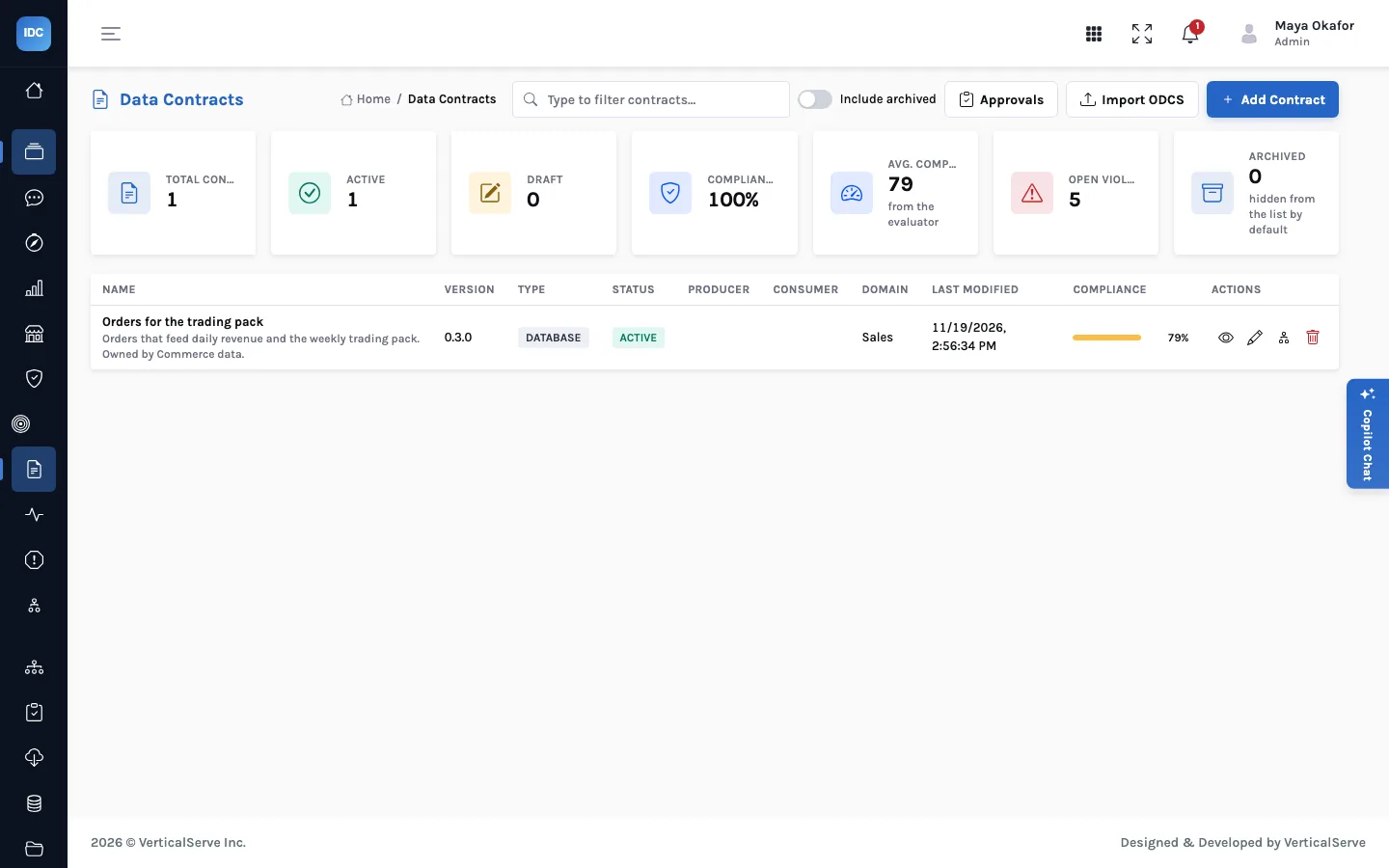
Lineage diagrams are easy to draw and hard to believe. The usual failure is not a missing edge; it is an edge nobody can explain. Was it parsed from SQL, typed in by someone two years ago, or guessed? InsightDataCatalog's answer is simple to state: every edge says how it was found, and how sure we are. The lineage explorer shows that on the line itself.
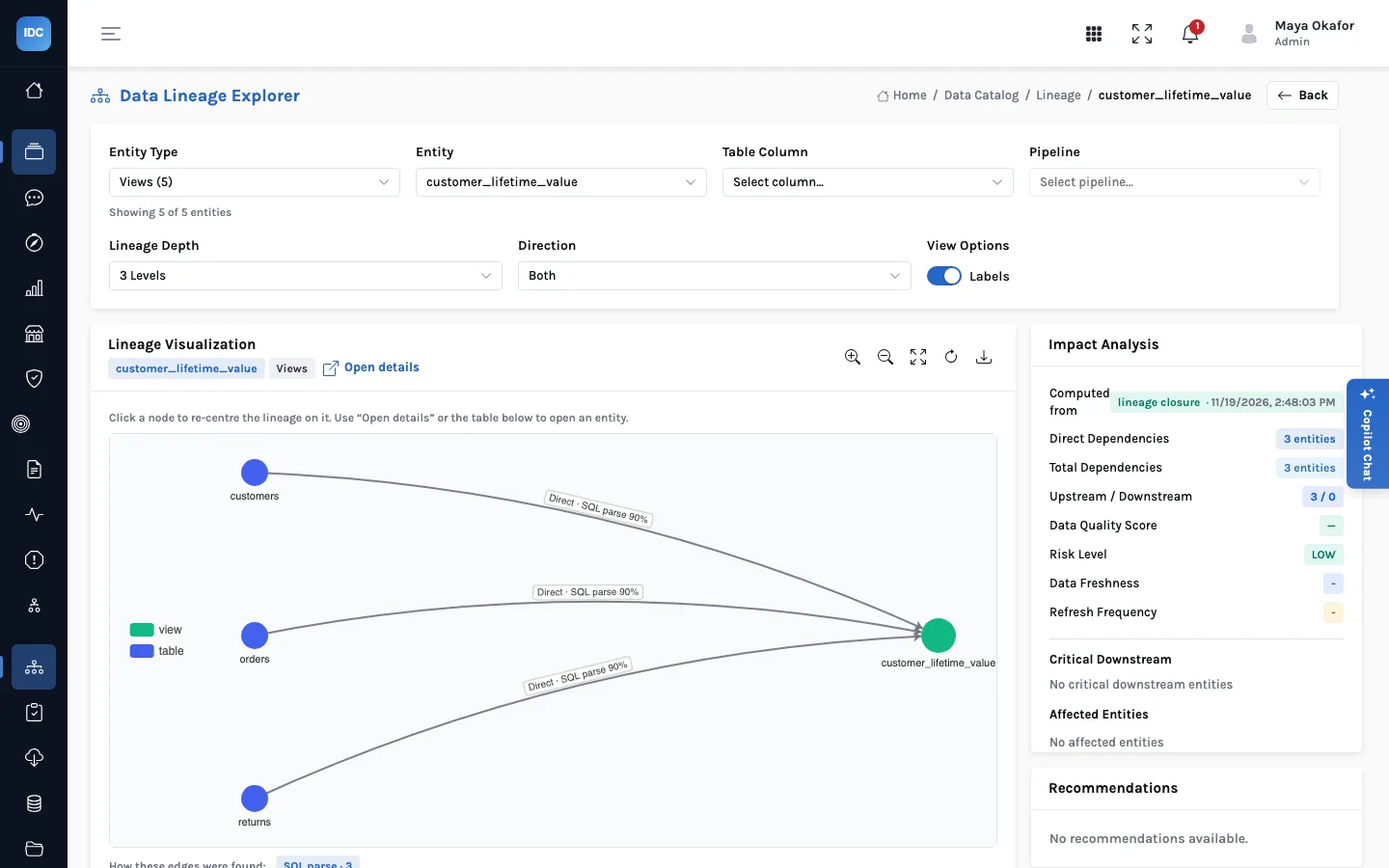
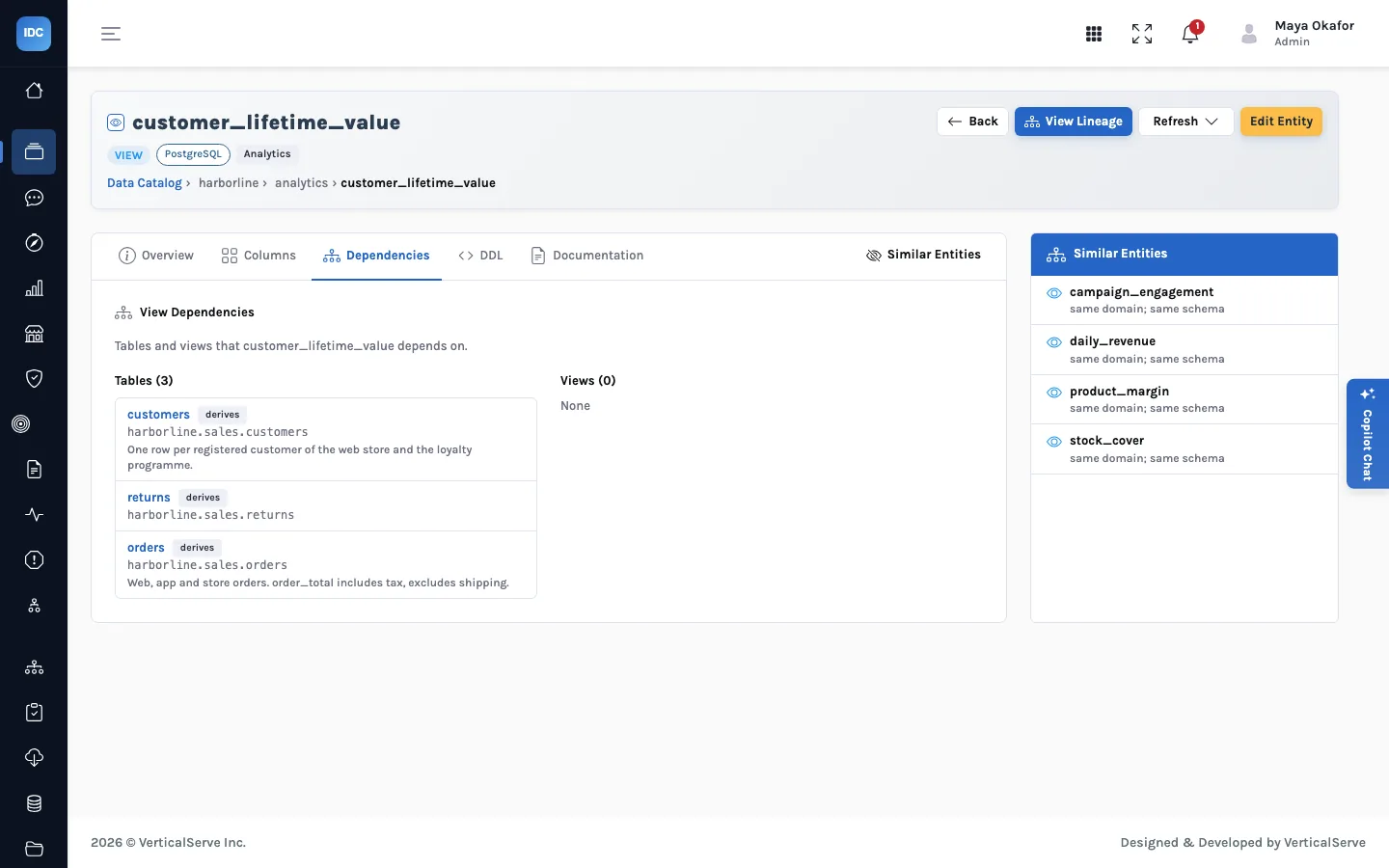
customer_lifetime_value, with its three source tables. Each edge is labelled with its method and confidence: Direct · SQL parse 90%.Where edges come from
The lineage job runs a set of parsers, each reading one kind of evidence:
- Views and stored procedures: the DDL is parsed with a SQL parser and qualified against the catalog's schema map, producing table edges and, where the columns can be placed, column edges.
- BI: the custom SQL behind Tableau data sources (and the live Tableau lineage API when enabled).
- Platform lineage: Unity Catalog system tables, Redshift query logs (opt-in), and OpenLineage events from runs.
- Pipelines: Airflow DAG and task metadata, dbt projects (manifest, run results, catalog) from a connected repository, and Kafka schema-registry subjects.
Every job is idempotent: edges are upserted by source, destination, type and job. A full re-parse closes (gives an end date to) any edge the new parse no longer finds, and nothing is deleted, so you can ask what the lineage looked like last quarter.
A confidence that means something
Confidence is "how sure are we that data flows along this edge", and it is set by how the edge was learned, not by taste. The scale is enforced on every write, with a cap per method:
Two practical consequences. First, you can weigh an answer: an impact analysis built on observed and parsed edges is a different thing from one that leans on declared or unplaced edges. Second, the explorer tells you, under the graph, how the edges on screen were found ("SQL parse · 3" in the example above), so a reader knows what they are looking at.
People and AI can propose; someone approves
Some lineage cannot be parsed: a file dropped by a vendor, a spreadsheet step, a stored procedure the parser rejects. For those, edges can be proposed by an AI fallback, by an AI client through MCP, or by a person. Proposals land in a review queue (Lineage Proposals). Approving one writes the edge as manual with confidence 1.0, because a person vouched for it, while keeping the proposer's method and confidence in its evidence. Rejecting one records a suppression, so no parser re-creates it on the next run.
Impact analysis without a graph walk
"What breaks if I change this?" is a transitive question: not only the views that read a table, but everything that reads those views. Walking a large graph for every question is slow, so the catalog keeps a closure: for every pair of connected datasets, the shortest depth between them, and the same for columns up to a bounded depth. It is maintained incrementally (an edge change only recomputes the rows of the sources that can reach it), with a nightly rebuild as a safety net. That is what fills the Impact Analysis panel: direct and total dependencies, upstream and downstream counts, critical downstream entities and the risk level.
Column-level lineage
Where the parser can place columns, edges are written column to column (DIRECT or IDENTITY transformations, for example), so
"where does net_value come from?" resolves to orders.order_total and returns.refunded. Each
entity's Columns tab has a lineage link per column, and tables have a Column Lineage tab.
Names that do not resolve
Parsers find names, and not every name is a catalog entity. A view may read a table in another system that has not been connected, a procedure may write a temporary table, or a BI query may spell a database differently from the connection. Those endpoints are kept as unresolved nodes rather than dropped, which is why the confidence scale has a low band for them.
The unresolved-names queue groups them by pattern (not in the catalog, cross-system, temporary table and so on), with counts and sample edges, most-connected first. Resolving one merges it into the right entity, moving its edges with it. Resolving with remember stores an alias rule, so the same raw name is placed automatically on every later run, and any other unresolved node the new rule matches is merged straight away. A small number of rules usually covers a large share of the queue, because the same few spellings repeat.
Runtime lineage, in and out
Where you run an OpenLineage-emitting scheduler, its run events can be posted to the catalog with an API key or a user token. A completed run's observed reads and writes score highest on the scale; a run still in progress scores lower, because it may yet fail. The catalog also returns any job's or dataset's lineage as an OpenLineage run event, so other tools can read what it knows. Each edge keeps its history across runs, and each parsed SQL statement is stored once with its parse status and the edges it produced, so "why does this edge exist?" can be answered by opening the statement.
Worked example: before dropping a column
Can returns.refunded be renamed?
Tomas, a fictional engineer at Harborline Outfitters, wants to rename returns.refunded to refund_amount. He opens the column's lineage from the table's Columns tab: one downstream column, customer_lifetime_value.net_value, through a parsed view at 90%. The table's impact panel shows the view as the only downstream dataset. The catalog can also list every path data takes between two datasets; from returns to the view there is one, so the change is one view edit. He notes that the edge is parsed, not observed: a BI extract that reads the table outside SQL the catalog can see would not appear, so he also tells the view's owner. An illustration on made-up data.
Using lineage well
- Before a change: open the table, check downstream counts and critical downstream entities, then notify the owners listed on them.
- During an incident: walk upstream from the broken report to the first failing load. Pair it with the Operations page, which lists what broke recently and what it affects.
- For audits: export the lineage of a critical data element from the explorer, and read the method on each edge before you rely on it.
Questions to ask of any lineage tool
- For a given edge, can I see the evidence: the statement, the run or the person who approved it?
- What happens to names the parser cannot place? Are they dropped, guessed or queued?
- If an edge disappears from the source, is it deleted or closed with a date?
- Can a rejected suggestion come back on the next run?