Most organisations have a few hundred numbers that really matter: the ones in the board pack, the regulatory return, the customer statement. Governance frameworks call the data behind them critical data elements (CDEs) and ask for three things: a shared definition, a named owner, and evidence that the data is fit for use. InsightDataCatalog builds CDEs on top of the business glossary, so the definition, the owner and the evidence live in one place.
Harborline's finance lead and the numbers in the board pack
Sasha, head of financial planning at the fictional Harborline Outfitters, chairs a small data council with commerce and supply chain. The board pack reports net revenue, gross margin and available stock. Each has been defined three different ways in the last year. Sasha wants one definition each, an owner who signs it, and a daily score the council can look at.
Step 1: the glossary
A glossary holds business terms with a standard name, a description, business rules, synonyms, examples and an approval status, and each term can be linked to the catalog columns that carry it. Terms can be added one by one, imported from CSV, or discovered from the catalog with AI assistance when a model is configured.
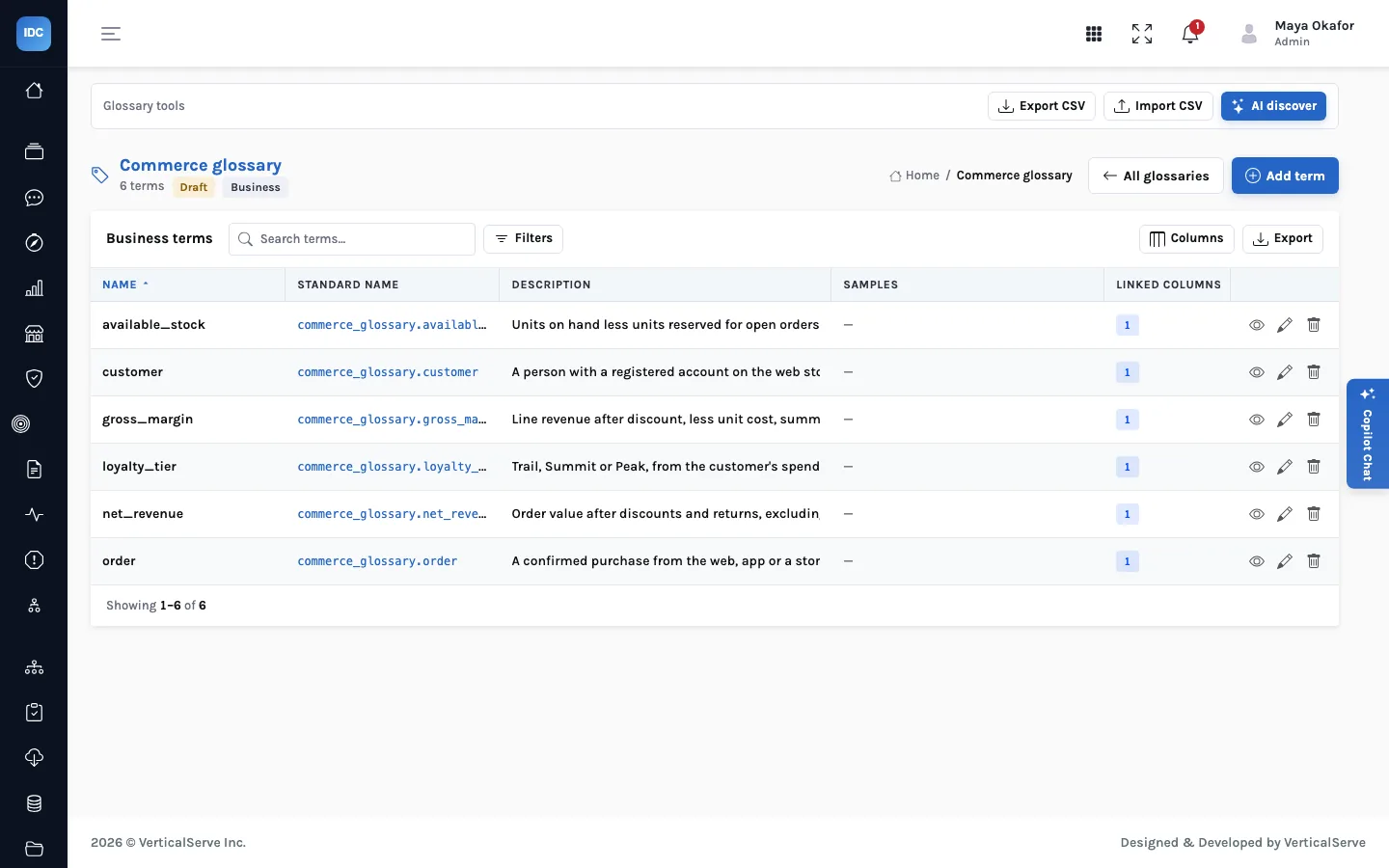
Sasha's council agrees six terms and links each to the column that carries it: net revenue to
sales.orders.order_total (with a business rule recording that tax and returns are taken off downstream), available stock to
inventory.stock_levels.on_hand, gross margin to the product cost column, and so on.
Step 2: from term to critical data element
A CDE is the governance facet of a glossary term: the same term, with a priority (P1, P2 or P3), a category, the data quality dimensions that matter for it (completeness, validity, accuracy, consistency, uniqueness, timeliness, integrity) with thresholds and weights, versioned rules, and bindings to the columns that carry it on each layer, with a role (source of record, conformed, reporting).
Candidates do not have to be found by hand. A CDE scan proposes both new CDEs and new bindings, as proposals a steward accepts or rejects:
- Bindings from lineage (a column copied directly from a bound column), glossary links, and name or synonym matches.
- New CDEs from a rubric: how far a column reaches downstream, whether it is a key or join column, and whether a data contract marks it required.
A rejected proposal stays suppressed for 180 days unless its evidence changes (for example, new lineage appears).
Step 3: sign-off that matches the stakes
A steward drafts the CDE and submits it; the steward step is signed on submission. A P3 element is then approved; a P2 needs the business owner; a P1 needs the business owner and the governance council. On the last signature the CDE is approved, and its draft rules and proposed bindings are approved with it. Changing an approved rule later creates a new draft version, which must be approved (by the steward for P3, the business owner for P1 and P2) before it replaces the old one, so only approved rule versions are scored. The CDE inbox shows each person what is waiting for their signature.
Three P1s and a P2
The council makes net revenue, gross margin and available stock P1: the steward drafts them, the commerce and supply-chain owners sign, and the council signs last. Loyalty tier becomes P2. The stock CDE gets a validity rule (never negative) bound on every layer the number passes through. An illustration on made-up data; the CDE screens are not shown because our test instance had no daily runs recorded.
Step 4: a daily scorecard that cannot hide a broken source
Every day, each layer's run plans one check per approved rule and approved binding, executes it read-only through each connection, and records the results. Scoring is deliberately strict:
- A rule's score is its pass rate. A CDE's score on one layer is the weighted mean of its dimension scores.
- A CDE's headline score is the lowest of its layer scores: a clean presentation layer cannot hide a broken landing layer.
- Status is green when every dimension meets its threshold, amber when the worst gap is at most two points, red otherwise.
- A layer whose load failed is not run (grey), never a false green; a check that could not execute is kept out of the score.
- Domains and lines of business are priority-weighted means (P1 counts three times, P2 twice, P3 once).
Failed checks on P1 and P2 elements raise alerts, and the results also appear in the Data Quality Studio and count in the evaluation of any data contract on the same tables.
Starting small
- Agree five to ten terms for the numbers in your most-read report, and link each to its column.
- Make them CDEs with a priority each; resist making everything P1.
- Pick two dimensions per CDE and one rule per dimension, bound on every layer the number passes through.
- Run the scan and work through its binding proposals; it finds the copies you forgot.
- Review the scorecard at the council's regular meeting, starting with anything red or grey.
Questions councils ask
Who counts as a business owner or council member?
Sign-off steps are tied to roles, and which identity roles count as steward, business owner or council is configured per deployment. An administrator can sign any step, which is useful in a trial and worth restricting in production.
What happens when a bound column is dropped?
The binding becomes orphaned, and the next scan proposes rebinding it to the closest column in the same table, for a steward to accept. The scan runs weekly by default.
Can the checks run inside our platform rather than through the catalog?
Yes, for Databricks: a job can ask the catalog for the day's planned checks, run them next to the data and post the results
back, and the catalog can generate the ALTER TABLE … SET TAGS statements that would tag approved bindings as Unity Catalog column
tags. Your Databricks administrator reviews and runs that SQL, so tags change only when a person applies them. Where nothing has triggered a layer's run by early
morning, the catalog's worker runs it as a fallback.
Next: a practical guide to your first week with the catalog.